Medically reviewed by Dr. Xavier Chong Shin Thong, MD
Founder of GP House Call
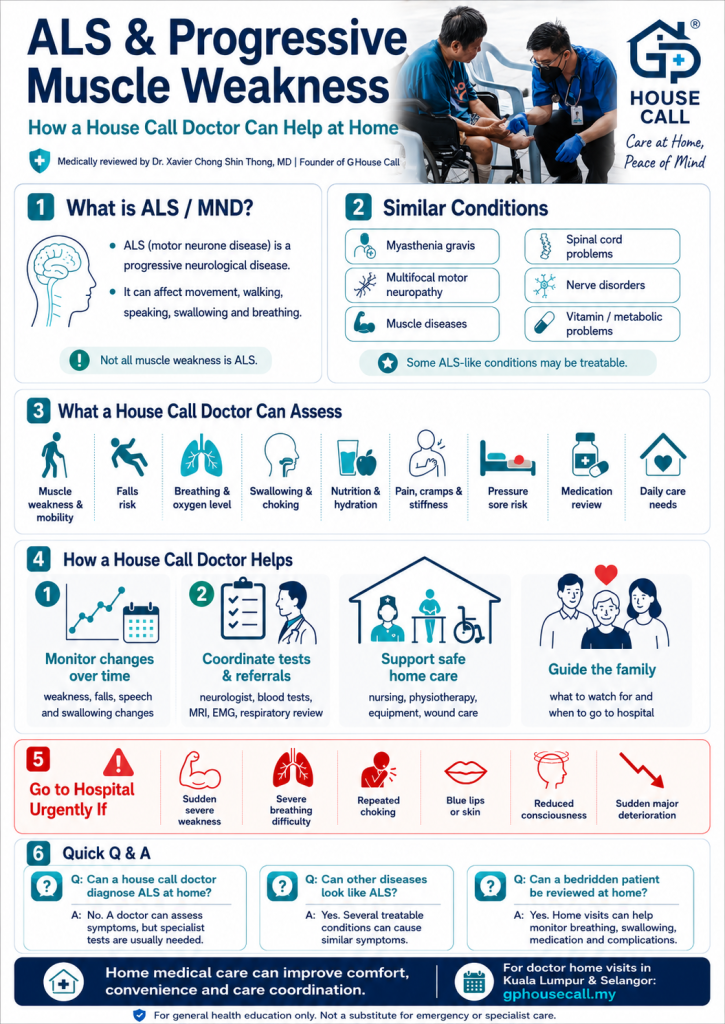
A house call doctor can help patients with ALS, motor neurone disease (MND) and other conditions that cause progressive muscle weakness by assessing symptoms at home, monitoring complications, reviewing medications and coordinating specialist, nursing, rehabilitation and hospital care.
However, a house call doctor does not replace a neurologist or emergency department when specialist investigations or urgent treatment become necessary.
What Is ALS or Motor Neurone Disease?
Amyotrophic lateral sclerosis (ALS) is a progressive neurological disease that damages the nerve cells that control voluntary muscles.
ALS belongs to the broader group of motor neurone diseases (MND).
According to the National Institute of Neurological Disorders and Stroke (NINDS), ALS can progressively affect movement, walking, speaking, swallowing and breathing.
Common symptoms may include:
- Progressive arm or leg weakness
- Difficulty walking
- Frequent falls
- Muscle wasting
- Muscle twitching
- Muscle cramps
- Weak hand grip
- Difficulty speaking
- Difficulty swallowing
- Weak cough
- Increasing breathing difficulty
Not All Muscle Weakness Is ALS
Importantly, several diseases can produce symptoms similar to ALS.
Examples include:
- Primary lateral sclerosis
- Progressive muscular atrophy
- Progressive bulbar palsy
- Spinal muscular atrophy
- Kennedy disease
- Multifocal motor neuropathy
- Myasthenia gravis
- Inclusion body myositis
- Cervical spinal cord compression
- Peripheral nerve disorders
- Certain vitamin or metabolic problems
Therefore, progressive muscle weakness needs proper medical assessment.
Some ALS-like conditions have specific treatments. As a result, doctors should not assume that every patient with progressive weakness has ALS.
How Can a House Call Doctor Help?
For a weak, elderly, disabled or bedridden patient, travelling repeatedly to a clinic can become exhausting.
A GP House Call doctor home visit allows a doctor to assess the patient in the familiar home environment. GP House Call currently provides home medical services across Kuala Lumpur and Selangor.
During a home visit, the doctor can assess:
- Muscle strength
- Walking and mobility
- Falls risk
- Ability to get out of bed
- Breathing pattern
- Oxygen saturation when clinically appropriate
- Cough strength
- Swallowing problems
- Choking episodes
- Nutrition and hydration
- Pain and muscle cramps
- Pressure sore risk
- Medication
- General medical condition
- Daily care needs
Additionally, seeing the patient at home helps the doctor understand the patient’s actual mobility, home environment and caregiver challenges.
1. Monitor Changes in Muscle Weakness
Progressive neurological diseases may change over time.
Therefore, regular home medical reviews can help monitor:
- Increasing weakness
- New falls
- Loss of mobility
- Difficulty transferring from bed to chair
- Increasing dependence on caregivers
- New speech changes
- Increasing swallowing difficulty
If the pattern raises concern, the house call doctor can recommend further neurological assessment.
2. Arrange Specialist Investigation When Needed
A house call doctor cannot confirm ALS through a home examination alone.
Further assessment may require:
- Neurologist consultation
- Blood tests
- MRI scans
- Electromyography (EMG)
- Nerve conduction studies
- Respiratory assessment
- Swallowing assessment
Therefore, the home doctor can act as a medical coordinator between the patient, family and specialist team.
The NICE guideline on motor neurone disease recommends coordinated assessment and management of mobility, nutrition, communication, respiratory function and other care needs.
3. Monitor Breathing Problems
ALS and some neuromuscular diseases can weaken the muscles required for breathing.
Families should watch for:
- Shortness of breath
- Difficulty breathing when lying flat
- Weak cough
- Difficulty clearing phlegm
- Disturbed sleep
- Morning headaches
- Increasing daytime sleepiness
Importantly, a normal pulse oximeter reading does not rule out respiratory muscle weakness.
Therefore, patients with suspected breathing muscle weakness may need specialist respiratory testing.
4. Check Swallowing and Nutrition
Muscle weakness can also affect swallowing.
Warning signs include:
- Coughing during meals
- Choking while drinking
- Taking much longer to eat
- Difficulty chewing
- Food remaining inside the mouth
- Unexplained weight loss
- Poor fluid intake
A doctor can assess the problem and coordinate further care with a neurologist, dietitian or swallowing specialist when required.
5. Prevent Problems From Immobility
Patients who spend long periods in bed or in a chair have a higher risk of complications.
Common problems include:
- Pressure sores
- Constipation
- Joint stiffness
- Muscle deconditioning
- Falls
- Poor nutrition
- Skin infections
- Increasing dependence
Therefore, early prevention becomes important.
Families can also read the GP House Call guide on bedridden patient care at home.
6. Review Medication and Symptoms
Patients with neurological diseases may take several medications.
A house call doctor can review:
- Current medication
- Medication interactions
- Pain
- Muscle cramps
- Constipation
- Excessive secretions
- Sleep problems
- Hydration
- Other chronic medical conditions
Moreover, medication reconciliation becomes especially important for elderly patients who take multiple medicines.
7. Coordinate Home Care Services
ALS and similar diseases often require more than one healthcare professional.
Depending on the patient’s condition, care may involve:
- Neurologist
- House call doctor
- Respiratory physician
- Physiotherapist
- Occupational therapist
- Dietitian
- Speech and swallowing therapist
- Home nurse
- Palliative care team
- Medical equipment provider
A home doctor can help coordinate these services and identify which support the patient needs next.
See the available GP House Call home healthcare services.
8. Support Bedridden or Frail Patients at Home
As muscle weakness progresses, transporting a patient may become difficult.
A home visit can reduce unnecessary travel for routine medical assessment.
However, the doctor must still identify situations that require hospital treatment.
The goal of home medical care is not to avoid hospitals at all costs. Instead, it helps patients receive suitable care at the most appropriate place.
When Should the Patient Go to Hospital?
Seek urgent or emergency medical care for:
- Sudden severe weakness
- Possible stroke symptoms
- Severe breathing difficulty
- Blue lips or skin
- Repeated severe choking
- Inability to clear airway secretions
- Severe chest pain
- Markedly reduced consciousness
- Sudden major deterioration
A house call service should never delay emergency treatment.
Frequently Asked Questions — ALS & Home Care
Can a house call doctor diagnose ALS at home?
No. A doctor can assess symptoms and neurological signs at home. However, ALS usually requires specialist neurological assessment and investigations such as EMG, nerve conduction studies and imaging.
Can other diseases look like ALS?
Yes. Myasthenia gravis, multifocal motor neuropathy, spinal cord compression, muscle diseases and several other conditions can cause similar symptoms.
Therefore, proper investigation remains important.
Can ALS patients receive medical care at home?
Yes. Many aspects of ongoing care can take place at home, including clinical reviews, medication assessment, symptom monitoring and coordination of nursing or rehabilitation services.
However, specialist tests and some treatments still require a hospital or specialist centre.
Can a house call doctor help a bedridden ALS patient?
Yes. A home doctor can assess the patient’s medical condition, breathing, swallowing, hydration, medication, pressure sore risk and other complications.
The doctor can also coordinate additional services when required.
When should a patient with muscle weakness see a doctor?
Arrange medical assessment when muscle weakness:
- Progressively worsens
- Causes repeated falls
- Affects walking
- Affects hand function
- Causes muscle wasting
- Affects swallowing
- Affects speech
- Causes breathing problems
Early assessment can help identify the cause and guide the next step.
Does a house call doctor replace a neurologist?
No.
The house call doctor and neurologist have different roles.
The neurologist focuses on diagnosis and specialist neurological management. Meanwhile, the house call doctor can monitor day-to-day medical problems and help coordinate care at home.
House Call Doctor for ALS, MND & Progressive Muscle Weakness in Kuala Lumpur and Selangor
Patients with ALS, motor neurone disease or other neurological conditions may eventually find clinic visits physically difficult.
A house call doctor can bring appropriate medical assessment closer to the patient.
Home medical support may help with:
- Regular medical review
- Progressive weakness monitoring
- Medication review
- Breathing assessment
- Swallowing and nutrition monitoring
- Bedridden patient care
- Pressure sore prevention
- Caregiver guidance
- Nursing coordination
- Specialist referral
- Palliative and comfort-focused care
For information about doctor home visits in Kuala Lumpur, Petaling Jaya and Selangor, visit GP House Call or contact GP House Call. Current contact information and service details appear on the official GP House Call website.
Trusted Medical References
- National Institute of Neurological Disorders and Stroke — Amyotrophic Lateral Sclerosis
- Mayo Clinic — Amyotrophic Lateral Sclerosis (ALS)
Medically reviewed by:
Dr. Xavier Chong Shin Thong, MD
Founder of GP House Call
This article provides general health information only. It does not replace an individual medical assessment, neurologist consultation or emergency medical treatment.